Algorithms and Custom Optics Map Solar Corona During 2026 Eclipse
Mathematician Miloslav Druckmuller and the Solar Wind Sherpas use numerical image processing and narrowband filters to track superhot coronal iron ions.
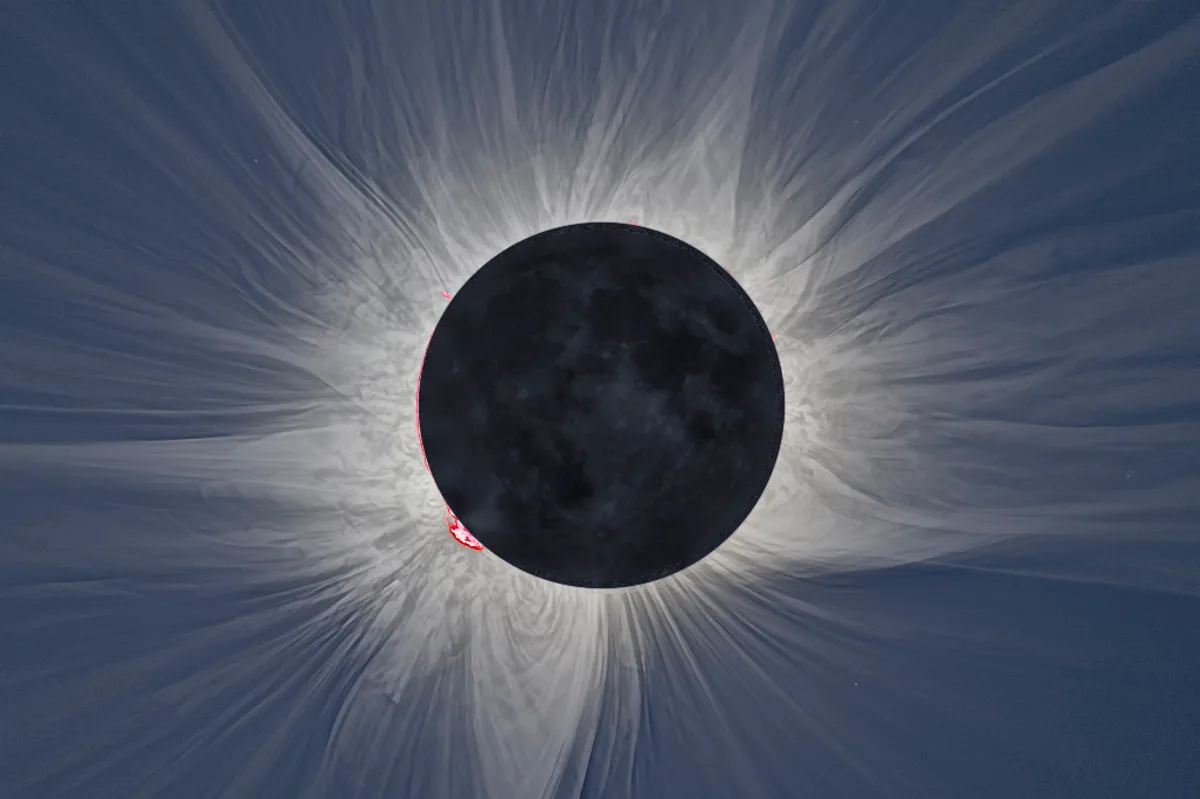
From a 1,600-meter slope on Pico Trigaza in north-central Spain's Castile and Leon region, mathematician Miloslav Druckmuller and a team of researchers deployed 20 astrophotography cameras and custom numerical algorithms on Aug. 12, 2026, to capture high-resolution data of the solar corona during a 107-second total solar eclipse. According to a report by IEEE Spectrum, the expedition combined custom eight-camera spectral assemblies with intensive computational image processing to track the dispersal of superheated iron ions into interplanetary space. While cloud cover from a vast low-pressure system blocked three partner teams stationed in Iceland, the Spanish mountain site cleared 10 minutes before totality, enabling the researchers to record critical visible-light and emission-spectra datasets just 51 minutes prior to sunset.
The successful data capture demonstrates how advanced numerical image processing and cost-effective ground-based optical engineering can overcome physical limitations that restrict multi-million-dollar spaceborne observatories. By resolving the innermost regions of the sun's outer atmosphere without the optical diffraction artifacts inherent to artificial spacecraft coronagraphs, this computational imaging methodology provides solar physicists with unprecedented empirical data on coronal heating mechanisms and solar wind acceleration—phenomena that directly govern space weather and satellite infrastructure resilience.
Bridging the Diffraction Gap Through Ground-Based Computation
The solar corona presents a persistent observational challenge for astrophysicists. Although the corona is approximately one million times dimmer than the sun's visible photosphere, its temperature reaches roughly 1 million degrees Celsius, compared to 5,500 degrees Celsius on the solar surface. Observing this faint outer atmosphere in visible light requires blocking the overwhelming glare of the solar disk. Space-based coronagraphs accomplish this using an opaque occulting disk, and the European Proba-3 mission, launched in 2024, simulates eclipses by flying two spacecraft 150 meters apart. However, light diffraction around artificial occulters forces engineers to block a wider area than the solar disk itself, obscuring the inner corona where core magnetic and thermal processes occur.
Total solar eclipses bypass this physical barrier because the moon's distance and apparent size cover the solar disk precisely without diffraction. While spacecraft such as NASA's Solar Dynamics Observatory capture the inner corona in extreme ultraviolet wavelengths, those signals attenuate rapidly with distance from the sun.
"But it cuts off very quickly, so you don't see its extension into space as well as we can see it in the visible emission lines during an eclipse. That's the biggest advantage of solar eclipse photography."
That assessment comes from Shadia Habbal, a solar physicist at the University of Hawaii and leader of the international Solar Wind Sherpas research collective. Habbal partnered with Druckmuller, a professor of mathematics and image processing at the Brno University of Technology in the Czech Republic, after his numerical processing of a 1999 eclipse in Hungary revealed fine coronal magnetic field lines previously unseen in standard astrophotography.
Algorithmic Calibration and Narrowband Ion Spectroscopy
Translating raw eclipse photography into scientific-grade coronal maps requires overcoming extreme dynamic range constraints. During totality, the brightness ratio between the darkest and brightest regions of the corona spans roughly 1-to-1,000,000, whereas standard computer monitors typically display a contrast ratio near 1-to-800. To bridge this gap, Druckmuller's team captures 200 individual exposure frames during totality, with shutter speeds ranging from 0.001 second to two seconds.
Those raw exposures are then processed alongside massive calibration datasets, including flat fields to correct for optical defects, dust, and pixel sensitivity variations, as well as dark frames to eliminate camera sensor noise. In total, generating a single composite coronal image requires approximately 3,000 input frames and more than 48 hours of dedicated computer processing time.
"Milos's processing brings out details that nobody has seen before, and they tell you a lot about very tiny features in the corona that you don't see otherwise."
Beyond broadband visible light, the Pico Trigaza expedition deployed a specialized eight-camera optical instrument engineered to isolate specific emission spectra from ionized iron atoms. Built using 3D-printed brackets from Brno University of Technology, laser-cut aluminum plates, discounted Contax lenses purchased via eBay, and mirror-like interference filters with a one-nanometer bandwidth, the array targets different ionic species of iron. Because stripping 11 electrons from an iron atom requires temperatures around 1.4 million degrees Celsius—while stripping 12 electrons requires roughly 1.6 million degrees Celsius—measuring the relative abundance and spatial distribution of these ions allows researchers to map thermal gradients across the corona. This hardware-software pipeline previously enabled the discovery of coronal plasma structures dubbed "smoke rings" and identified the boundary zone where solar plasma thins to the point that ions cease colliding.
Data Processing Timelines and Future Expeditions
Operating at an altitude of 1,600 meters on Pico Trigaza—just 11 kilometers from the eclipse shadow's centerline—helped the Brno University team, including assistant professor Jana Hoderova and five doctoral candidates, mitigate atmospheric distortion caused by the sun sitting just 8 degrees above the horizon during totality. Having traveled over 2,000 kilometers from the Czech Republic and powered their 20-camera array via a car battery to buffer against electrical grid instabilities, the researchers secured complete datasets across both visible-light and narrowband iron-ion channels.
While preliminary visible-light composites of the August 2026 corona are scheduled for release within two weeks of the event, the complex numerical calibration and thermal analysis of the multi-spectral iron-ion datasets will require several months to a full year of computation. Druckmuller noted that the full spectroscopic findings will likely be finalized just ahead of the team's next planned deployment for the 2027 total solar eclipse in North Africa.