US Shipbuilding Revival Faces Scrutiny Over Fossil Fuel Cargo Focus
Hanwha Group's Philadelphia shipyard anchors Washington's maritime industrial push, yet reliance on fossil freight orders raises long-term transition risks.
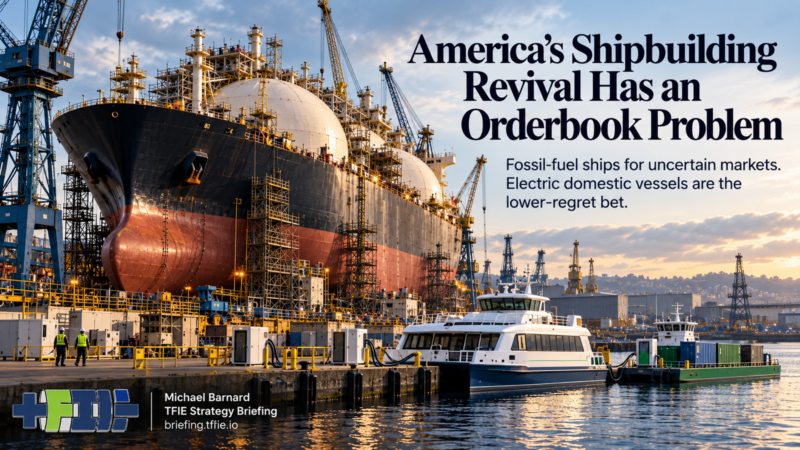
South Korea’s Hanwha Group has positioned its Philadelphia shipyard at the center of Washington’s campaign to revitalize American commercial shipbuilding, even as new vessel orderbooks remain heavily weighted toward fossil fuel freight, according to a report by CleanTechnica. Acquired by subsidiaries Hanwha Ocean and Hanwha Systems in December 2024, the Pennsylvania facility is designed to rebuild domestic maritime manufacturing capacity, sustain specialized industrial jobs, and transfer advanced Korean shipbuilding technology to the United States. However, industry analysts tracked by CleanTechnica warn that anchoring this high-cost industrial revival on fossil-fuel transport vessels creates substantial long-term financial and environmental vulnerabilities.
The tension between industrial policy and decarbonization carries major implications for global capital markets, maritime logistics, and energy transition planners. Commercial vessels carry operational lifespans exceeding two to three decades, meaning capital committed today to liquefied natural gas, petroleum, or conventional carbon-intensive freighters risks becoming stranded assets as international maritime emissions regulations tighten. For enterprise shipowners and institutional financiers, the discrepancy between higher United States construction costs and shifting global fuel standards presents a complex capital allocation challenge.
Foreign Expertise Anchors Domestic Industrial Strategy
The revitalization of the Philadelphia yard relies directly on cross-border industrial integration between South Korean conglomerates and United States maritime regulators. When Hanwha Ocean and Hanwha Systems finalized their acquisition of the Philadelphia shipyard in December 2024, the transaction was structured to inject proven assembly-line discipline, digital shipyard management, and supply chain expertise into a domestic sector that had largely ceded commercial volume to Asian competitors over several decades.
According to CleanTechnica’s analysis of the domestic orderbook, the infusion of foreign capital and technical know-how successfully preserves domestic production lines and skilled trades in Pennsylvania. Yet the underlying commercial demand driving these domestic slipways remains tethered to legacy energy transport rather than zero-emission propulsion or clean-tech logistics vessels. Because domestic construction under United States cabotage and industrial support frameworks commands a significant price premium over international yards, buyers require decades of guaranteed charter revenue to justify the capital expenditure.
The investment creates and sustains American production capacity and jobs while transferring shipbuilding expertise and technology, yet new orders represent expensive bets on fossil freight.
Economic Pressures and Stranded Asset Risks in Maritime Freight
The economic structure of American commercial shipbuilding amplifies the financial exposure of ordering fossil-linked tonnage. Constructing commercial vessels in United States shipyards historically costs multiples of equivalent builds in South Korea, Japan, or China due to fragmented domestic supply chains, higher labor rates, and lower series-production volume. While Hanwha Group’s December 2024 intervention aims to narrow this productivity gap through modular construction and automated welding systems, early orderbooks still reflect elevated baseline capital costs.
CleanTechnica highlights that pairing high upfront shipyard capital expenditure with fossil fuel cargo business models compounds balance-sheet risk for maritime operators. Global shipping faces escalating regulatory compliance costs alongside projected declines in seaborne fossil fuel volumes over the life of a newly commissioned hull. If demand for petroleum products or fossil gas cargoes plateaus before these domestically built vessels fully amortize their construction premiums, charterers and maritime lenders could confront compressed day rates and premature vessel write-downs.
Strategic Outlook for Clean Maritime Manufacturing
Looking ahead, the durability of Washington’s shipbuilding revival will depend on whether facilities like Hanwha’s Philadelphia yard can pivot their production pipelines toward decarbonized propulsion, offshore wind support vessels, and green corridor container ships. Technology transfer from Hanwha Ocean and Hanwha Systems provides the engineering foundation to build dual-fuel, battery-hybrid, or alternative-fuel vessels once domestic commercial buyers align procurement with climate targets.
Over the coming quarters, maritime investors and policy analysts will monitor whether federal industrial incentives and fleet modernization programs begin conditioning subsidies on clean propulsion standards. Until procurement shifts away from fossil freight, America’s commercial shipbuilding resurgence will remain caught between immediate industrial job creation and the accelerating structural transition of global energy trade.