ETH Zurich Researchers Unveil Collision-Resilient Hollow Ring Drone
By replacing rigid central frames with a flexible fiberglass ring, the FlexiQuad absorbs midair impacts while maintaining high-speed maneuverability.
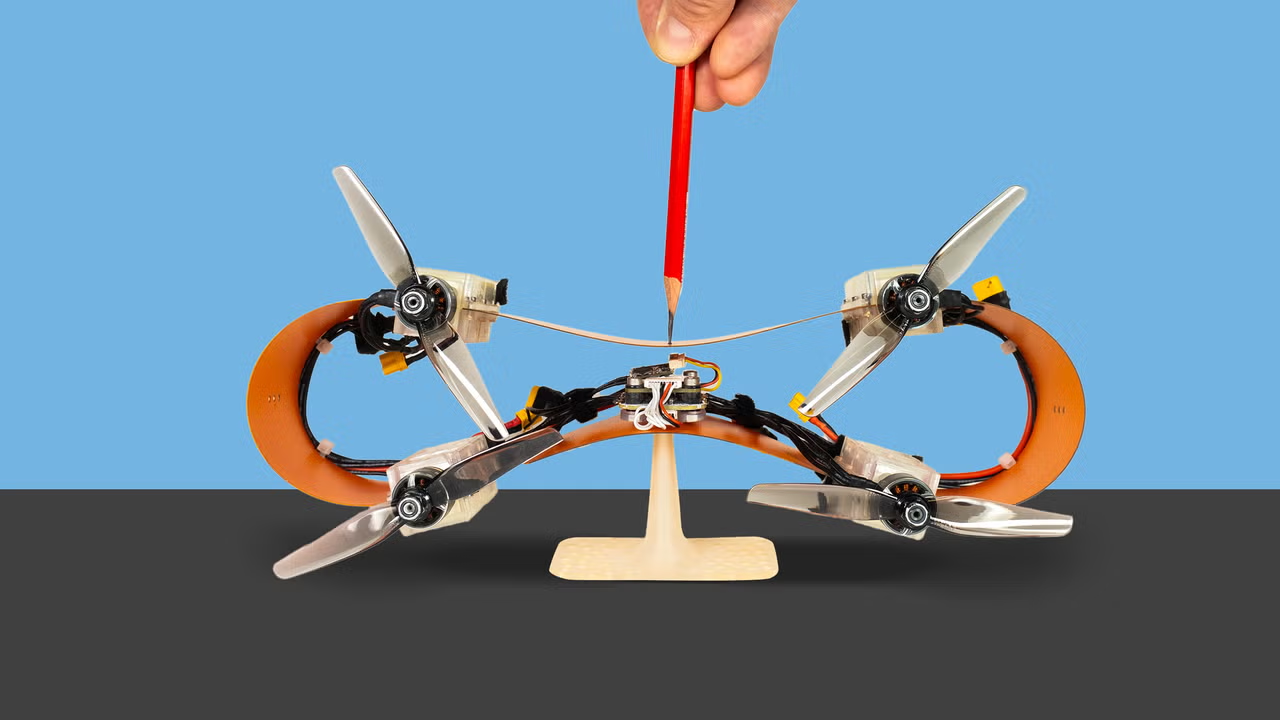
Researchers associated with ETH Zurich have engineered an unconventional quadcopter architecture that replaces the traditional rigid central body and stiff arms with a hollow, flexible ring capable of absorbing direct physical impacts in midair. Developed by engineer Luca Girardi alongside Stefano Mintchev, a former professor at ETH Zurich's Environmental Robotics Lab, the prototype—dubbed FlexiQuad—distributes its batteries, sensors, and electronics evenly around a compliant perimeter rim, according to a report by Fast Company and a non-peer-reviewed preprint paper published on arXiv. When the unmanned aerial vehicle collides with an obstacle such as a wall or tree trunk, the outer ring buckles laterally to dissipate kinetic force before rebounding and stabilizing itself to continue flight.
For enterprise robotics, industrial inspection, and civil defense operators, mechanical fragility remains one of the primary operational bottlenecks limiting autonomous drone deployment inside confined or cluttered environments. Conventional quadcopters rely on rigid structural frames that transfer collision forces directly to vulnerable rotors and central avionics, frequently resulting in catastrophic failure upon impact. By proving that a compliant airframe can survive head-on collisions without sacrificing speed or thrust stability, the FlexiQuad architecture offers a low-cost mechanical blueprint for unmanned systems operating in high-risk zones—ranging from maritime ballast tanks and collapsed structures to urban airspace defense.
Biomimetic Engineering and Anisotropic Stiffness
Girardi, who spent approximately five years refining the concept, drew structural inspiration from the biomechanics of avian and insect flight. Rather than constructing an uniformly rigid or uniformly soft airframe, the researchers focused on what engineers classify as anisotropic stiffness—a structural property in which a material resists deformation along certain axes while yielding along others.
"We were interested in how stiff their wings are and how they bend them—or don't bend them—in different directions," Girardi said in a statement. "At first, I was skeptical whether the drone would fly without the central reinforcement. But I really liked the approach. Then we tried it—and it worked."
In standard quadcopter engineering, simply swapping rigid arms for flexible materials creates severe flight control instability. Soft arms bend upward under the vertical thrust of the propellers, inducing mechanical oscillations and wobbling around a heavy central battery core. As Girardi told Fast Company, rethinking both mass distribution and bending geometry was essential to solving this control challenge.
"The key was to rethink where the weight sits, as well as where the structure bends," Girardi explained. "A heavy central body supported by flexible arms can introduce bending and oscillations."
By relocating the battery units directly beneath the four rotors along the outer perimeter, the engineering team eliminated the need for a central core altogether, resulting in a vertically flat, donut-like silhouette. The ring remains vertically rigid so the propellers can lift the airframe without sagging, while flexing horizontally to cushion lateral collisions. According to the researchers' findings, the optimal stiffness range for the frame aligns closely with the natural wing compliance observed across biological flyers, scaling effectively for drone weights ranging from less than one ounce up to approximately 6.6 pounds.
Operational Metrics, Payload Utility, and Unit Economics
Quantitative testing documented in the team's arXiv preprint demonstrates how distributed mass and compliant materials improve both vibration damping and impact survivability. In computer simulations comparing the distributed-mass ring against an otherwise identical configuration housing a single central battery, the centralized design experienced 13 times more shaking at the rotors and eight times more vibration across the electronics during acceleration.
The physical prototype weighs 14 ounces and exhibits roughly 1,000 times greater flexibility than a standard quadcopter airframe. Despite its compliant structure, the craft achieves a top speed of 50 mph, accelerates at more than three times the force of gravity, and executes rapid lateral dodges. As Girardi noted in his statement, "Soft doesn't automatically mean slow."
According to Girardi and Mintchev's research data, the FlexiQuad is four times more collision-resilient than a conventional drone, surviving head-on impacts at roughly 11 mph without sustaining structural damage. Furthermore, the deformable geometry provides functional versatility beyond crash protection. The ring can compress to pass through apertures measuring 70 percent of its standard width, successfully navigating a 7-inch slot during testing. Although propeller overlap during compression reduces thrust efficiency from 79 percent to 68 percent, the aircraft remains airborne. In additional trials, the frame used its inward squeezing force as a mechanical gripper to wrap around, transport, and deposit a soft first-aid pouch, and demonstrated the capacity to lift payloads exceeding its own weight.
From a manufacturing and logistics perspective, the airframe is constructed from four thin strips of fiberglass laminate—the widely available substrate used in standard printed circuit boards—keeping raw structural material costs below $15, excluding motors, batteries, and avionics. For field transport, operators can unfasten quick-release latches and slide-in batteries to lay the ring completely flat inside a medium-size suitcase.
Commercialization Roadmap and Regulatory Hurdles
Despite earning a nomination for ETH Zurich's Spark Award for invention of the year and securing a pending patent application, the FlexiQuad faces technical and commercial milestones before reaching widespread enterprise adoption. The prototype currently stands at Technology Readiness Level 5 on NASA's nine-step scale, signifying validation in realistic environments, with engineering efforts underway to reach Level 6.
Technical hurdles still under refinement include autonomous spatial perception and post-impact optical stabilization, as structural rebounding temporarily blurs onboard camera feeds. However, the designers have already implemented reinforcement learning algorithms that give the drone an artificial intelligence reflex capable of reading motion sensors to automatically steady the craft after a crash without human pilot input. The researchers also noted that frame deformation itself could eventually serve as a tactile sensor, similar to how insects detect airflow and obstacles through wing flexion.
To transition the technology into the market, Girardi told Fast Company that the team is launching a startup focused on automating rapid drone design integrated directly with component suppliers, rather than solely manufacturing a single hardware model. Near-term field validation includes an upcoming pilot program testing a larger variant outfitted with an internal net across its hollow center to capture unauthorized drones in civilian airspace—addressing environments where kinetic interception poses debris hazards to bystanders or critical infrastructure—alongside ongoing evaluations with firefighters for search-and-rescue operations.