JAXA Leads International Mission to Land on Mars Moon Phobos
The Martian Moons eXploration spacecraft navigates complex microgravity physics and autonomous robotics to return the first samples from Phobos by 2031.
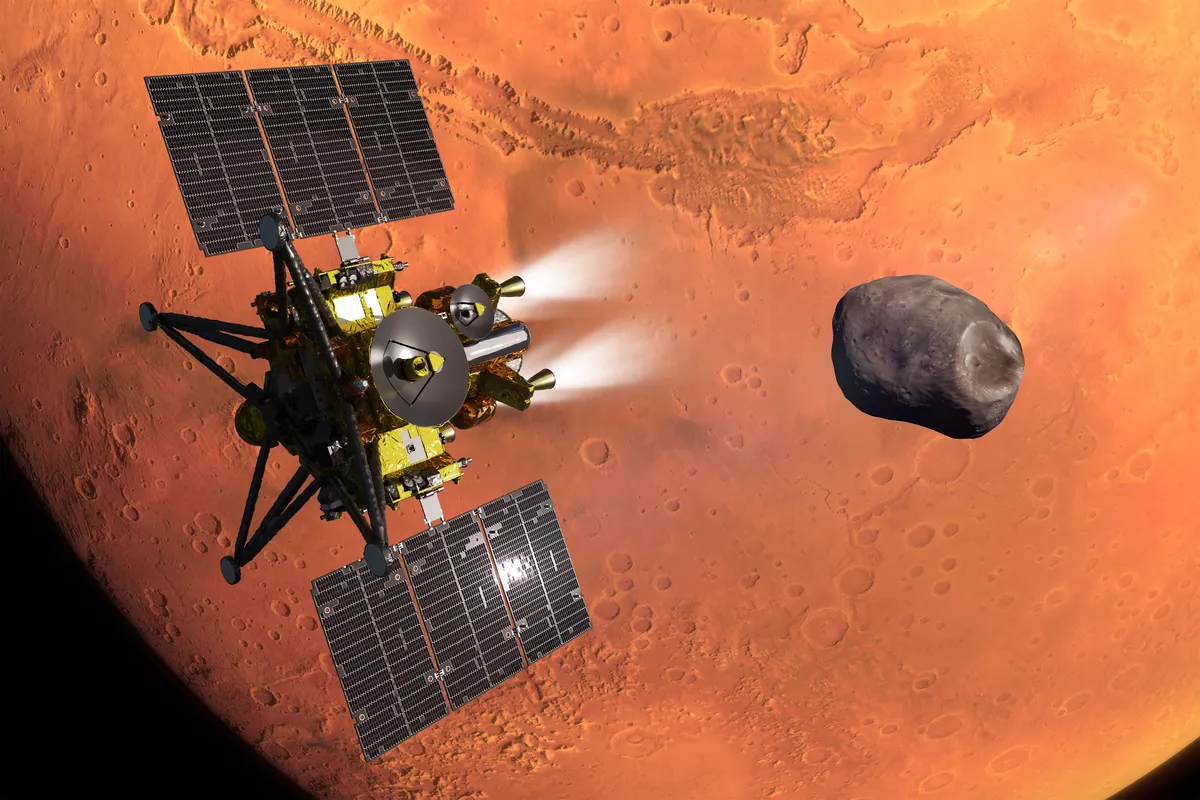
The Japan Aerospace Exploration Agency (JAXA), in collaboration with NASA and European space agencies, is executing a five-year deep-space expedition following the Oct. 20, 2026 launch of the Martian Moons eXploration (MMX) spacecraft aboard an H3 rocket from the Tanegashima Space Center. According to reporting by IEEE Spectrum, the three-module probe is currently cruising toward Mars, where it will arrive in 2027 to conduct an unprecedented series of microgravity landings on the enigmatic Martian moon Phobos before returning surface samples to Earth in the second half of 2031.
The mission represents a major milestone for international aerospace engineering, autonomous robotics, and planetary science. Navigating and sampling a rubble-pile celestial body that exerts only one-1,800th of Earth's gravitational pull requires newly developed astrodynamic trajectories, specialized low-traction locomotion systems, and dual-redundant pneumatic and mechanical excavation tools built by global aerospace contractors, including Blue Origin subsidiary Honeybee Robotics.
Navigating Microgravity and Orbital Mechanics
Measuring roughly 27 kilometers in length and shaped like an irregular potato, Phobos lacks sufficient mass to pull itself into a sphere or support a conventional spacecraft orbit. Scientists remain divided over whether Phobos and its smaller companion, Deimos, are captured asteroids from the main belt between Mars and Jupiter or coalesced debris from an ancient planetary impact on Mars. To study this loosely consolidated aggregate of rock and dust, MMX engineers designed a three-part spacecraft consisting of a propulsion module, an exploration module, and a sample return module.
Upon arriving at Mars in 2027, the spacecraft must execute a precisely timed braking burn to achieve planetary capture before jettisoning its propulsion unit. Because Phobos's gravitational field is too weak to anchor an orbiter directly, MMX will enter specialized quasi-satellite orbits that circle Mars while looping ahead of and behind the moon at distances ranging from 200 kilometers down to less than 20 kilometers.
"I often say that landing on Phobos is like trying to land a balloon. It's very difficult to drop a balloon to the ground and prevent it from tilting or bouncing." — Yasuhiro Kawakatsu, MMX Project Manager at JAXA
Nicola Baresi, an astrodynamicist who co-authored research on the mission's orbital mechanics, noted to IEEE Spectrum that any miscalculation during the initial Mars insertion burn could cause the spacecraft to fly past the planet and get catapulted into the solar system. During a two-year remote sensing campaign using the TENGOO camera and a LIDAR laser altimeter, MMX will map candidate landing zones at resolutions far surpassing the few-meters-per-pixel imagery currently available from NASA's Mars Reconnaissance Orbiter and the European Space Agency's Mars Express.
Autonomous Rover Deployment and Dual-System Sampling
Before risking the main spacecraft on Phobos's unpredictable terrain in 2028 or early 2029, JAXA will deploy a 23-kilogram scout rover named Idefix, developed jointly by the French National Centre for Space Studies (CNES) and the German Aerospace Center (DLR). Released from an altitude between 40 and 100 meters, the microwave-sized rover will freefall without airbags or thrusters, impacting at less than 1 meter per second and bouncing multiple times before coming to rest.
Stephan Ulamec, Idefix co-principal investigator and project manager at DLR, explained that the rover will then autonomously deploy four articulated legs to upright itself and unfold its padded solar panels. Across a planned 100-Earth-day primary mission, Idefix will crawl at a top speed of 1 millimeter per second using four nine-bladed paddle wheels. Faster movement in microgravity would cause the vehicle to swim through the regolith rather than drive across it, according to Cecily Sunday, a doctoral researcher testing the rover's underside WheelCams at ISAE-Supaero in Toulouse, France.
"It's the most complex mission I have ever seen." — Patrick Michel, Director of Research at the French National Center for Scientific Research (CNRS)
Data from Idefix's wheel tracks will provide sub-millimeter measurements of regolith porosity, grain size, and surface strength, guiding the exploration module's subsequent descent. The main lander will descend under thruster control to roughly 10 meters before dropping in freefall to prevent lateral drift. During a surface window of up to two hours, MMX will deploy two independent collection mechanisms to secure at least 10 grams of material:
First, a JAXA-developed robotic arm and cylindrical coring sampler will penetrate at least 2 centimeters beneath the radiation-weathered topsoil to retrieve pristine subsurface regolith. Second, a leg-mounted pneumatic sampler provided by NASA and fabricated by Honeybee Robotics will inject non-reactive nitrogen gas into the ground to stir up and capture surface grains, ensuring mission success even if subterranean rock proves impenetrable.
Planetary Protection and Long-Term Scientific Outlook
Beyond resolving the origin of the Martian moons, MMX offers a secondary scientific dividend: the potential retrieval of the first physical samples from Mars itself. Patrick Michel, director of research at CNRS and co-principal investigator on Idefix, estimates that Phobos's regolith may contain several hundred grains of Martian ejecta blasted into orbit by historical meteor impacts, which scientists can identify via oxygen isotope analysis. Crucially, an international panel of experts determined that any hypothetical Martian microbes would not survive the violent impact ejection and subsequent cosmic radiation exposure, exempting MMX from costly planetary-protection quarantine protocols upon return.
Following surface operations on Phobos and multiple observational flybys of Deimos, the exploration module will detach from the return unit during a favorable planetary alignment in November 2030. The 60-centimeter return capsule is scheduled to re-enter Earth's atmosphere at roughly 12 kilometers per second in the second half of 2031, targeting a landing zone in Australia. Curated by JAXA's Institute of Space and Astronautical Science, the samples will help planetary scientists determine how water and organic compounds migrated from the outer solar system to terrestrial worlds.